





There’s a conversation happening everywhere right now. In Facebook groups, Reddit threads, YouTube comments. Freelancers asking: “Will AI replace freelancers?”
It’s a fair question. But honestly, it’s also the wrong one.
After 8+ years working in online business and digital projects, I’ve seen waves of tools and trends come through. Some changed everything. Some faded quietly. AI is clearly in the first camp. But the freelancers who are struggling right now aren’t the ones competing with AI. They’re the ones who haven’t grown past “just okay” at what they do.
That’s the real threat. Not the technology. The comfort of staying average.
How the Freelance Market Changed After AI (A Honest Look)
I want to share something real before we get into the strategy part.
A few years ago, before AI tools became mainstream, the bar for freelance work was different. Not lower, exactly, but more predictable. A client who needed a video edited, a blog post written, or social media content created would come to a freelancer because there was no real alternative. The work was valued at face value. You did it well, you got paid, you moved on to the next project.
I remember working on content and digital projects where the scope was clear and the timeline was generous. Clients were happy with solid, consistent work. The relationship was straightforward.
Then things shifted.
When AI tools started becoming accessible to everyone, not just tech people, client expectations changed quietly but significantly. Suddenly, clients who used to wait a week for a first draft started wondering why it takes more than two days. Clients who used to hire a freelancer for basic editing started expecting polished, multi-format output. The work itself didn’t disappear. But what clients considered “good enough” moved up.
I noticed it in the way conversations started. Instead of “can you do this?”, it became “can you do this faster, can you add this format, can you also handle this part?” The scope kept expanding while the budget didn’t always follow.
And here’s what I realized: AI didn’t remove the need for freelancers. It changed what clients expect from them.
Tasks that used to take three days can now be done in one with the right tools and workflow. That’s genuinely useful. But it also means that freelancers who refuse to adapt are now being compared, fairly or not, to what AI can produce quickly and cheaply. The ones who adapted, who learned to use AI as part of their process rather than seeing it as a threat, found that they could actually deliver more value than before.
The role of a freelancer today is shifting toward someone who knows how to combine human judgment, creative thinking, and AI tools to produce faster, better results. That’s a different job than it was five years ago. But it’s still very much a job that exists and pays well.
What AI Actually Does (and Doesn’t Do)
Let’s be clear about something.
AI is genuinely good at certain things. It can write a first draft quickly, summarize long documents, generate content ideas, write basic code, and assist with creative direction. These are real capabilities worth taking seriously.
But here’s what AI still can’t do:
- Understand a client’s brand voice after one messy briefing call
- Navigate a difficult client relationship and know when to push back
- Bring a personal creative perspective built from years of real projects
- Build trust with someone over time
- Notice what a client actually needs, not just what they asked for
These things take experience. They take judgment. They take a person who has made mistakes, learned from them, and shows up with a real point of view.
No AI tool has that. You do.
The Real Problem: Average Work Is the First to Go
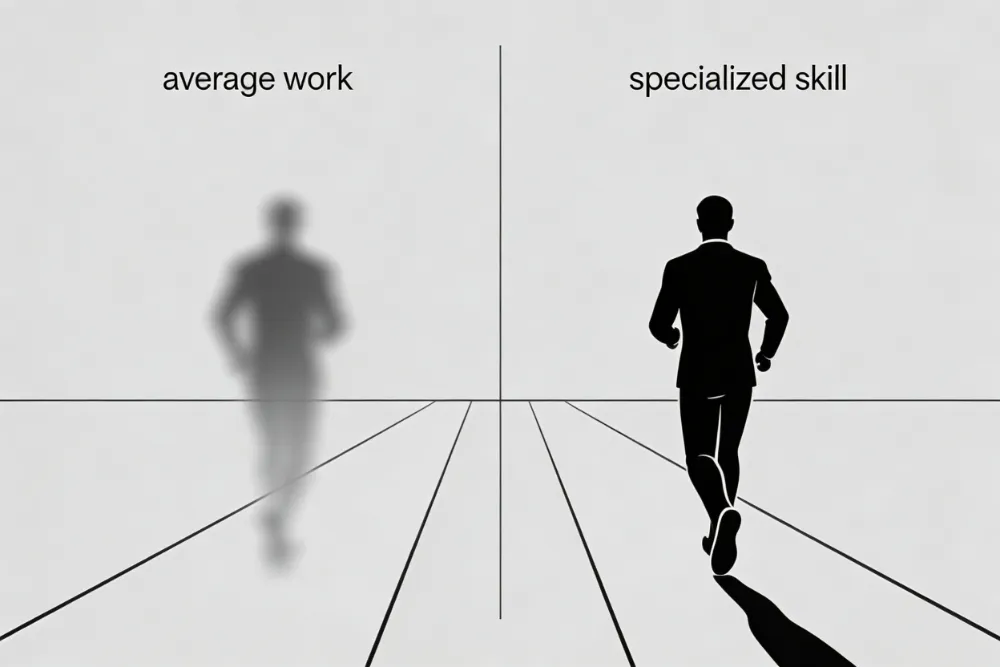
Here’s the uncomfortable part.
If your main value as a freelancer is “I write blog posts” or “I do graphic design,” and nothing more specific than that, you’re in a fragile position. Not because AI is better than you. But because clients who want average, fast, cheap output now have a tool that delivers exactly that.
According to Upwork’s Freelance Forward report, skilled freelancers with specialized expertise continue to see strong demand, while generalist work faces more pressure. The pattern is consistent across categories.
The freelancers losing work right now are mostly those who:
- Never developed a niche or real specialization
- Competed mostly on price rather than expertise
- Delivered technically fine work but nothing distinctive
- Treated every project as a transaction rather than a relationship
- Didn’t invest in learning new tools or evolving their process
None of that is AI’s fault. That positioning was already fragile. AI just made the weakness more visible.
What Strong Freelancers Are Actually Doing
I’ve worked alongside a lot of freelancers over the years. The ones doing well right now share a few clear habits.
They Got Specific About What They Do
Instead of “I’m a copywriter,” they became “I write email sequences for SaaS companies during product launches.” Instead of “I’m a video editor,” they became “I edit long-form YouTube content for finance creators.”
Specificity isn’t limiting. It’s what makes clients come to you instead of scrolling past you. A generalist competes with hundreds of people. A specialist is often the only obvious choice.
They Use AI as Part of Their Workflow
The freelancers doing well aren’t ignoring AI or fighting it. They’re using it to handle the repetitive, time-consuming parts of their process so they can put more energy into the work that actually requires human judgment.
A content writer using AI to research and outline spends more time on voice, story, and strategy. The client gets better work. The freelancer works smarter. That’s a real advantage, not a shortcut.
McKinsey’s research on automation and the future of work consistently shows that workers who combine technical skills with judgment and creativity are the most resilient to automation. That applies directly to freelancers.
They Focus on the Client Experience, Not Just the Output
This is something that doesn’t get talked about enough.
Clients don’t just remember what you made. They remember how the process felt. Did you communicate clearly? Did you ask the right questions early? Did you catch problems before they became expensive?
That experience is hard to put a price on, and impossible for any AI tool to replicate. A client who trusts you doesn’t shop around every time. That trust is one of the most valuable things you can build as a freelancer.
They Keep Learning Without Burning Out
Not chasing every trend. Not spending hours every day on YouTube watching tutorials. But consistently putting in time to stay current, one new skill per quarter, one tool explored per month. Staying curious rather than anxious.
LinkedIn’s 2024 Workplace Learning Report found that adaptability and continuous learning are among the top skills employers and clients look for. For freelancers, this translates directly into relevance.
A Simple Audit: How to Check Your Own Value
If you’re reading this and feeling uncertain about where you stand, here’s a practical exercise.
Ask yourself three honest questions:
1. What can I do that a well-crafted AI prompt cannot replace?
Think about your judgment, your relationships, your style, your experience. Write it down. Be specific.
2. Who benefits most from what I offer?
Not “small businesses” or “anyone who needs content.” Who exactly? The narrower and clearer your answer, the stronger your position.
3. What would a client actually miss if they used AI instead of me?
If you can’t answer this clearly, that’s your signal. Not to panic, but to work on it.
Your answers to these questions are your real competitive advantage. Build around them deliberately.
You Don’t Need to Become an AI Expert
A lot of advice right now tells freelancers to “learn AI,” “become a prompt engineer,” or rebuild their skill set from scratch. Most of that is noise.
You don’t need to be an AI expert. You need to be genuinely good at your craft, clear about who you serve, and willing to use AI as one useful tool among several. Like a photographer who doesn’t need to understand every technical spec of their camera. They need to know how to use it to create something worth looking at.
The fundamentals of good freelance work haven’t changed. Strong communication, reliable delivery, real expertise, and the ability to solve problems your clients don’t even know they have yet. Those things matter more now, not less.
This Moment Is Actually an Opportunity
A lot of average freelancers are leaving the market right now. They’re frustrated, pivoting out, or telling people AI ruined everything. That creates a gap.
Clients who want real quality, real strategy, and real creative thinking are looking harder than ever for someone who can actually deliver it. Harvard Business Review has written extensively about how automation tends to increase demand for high-skill, judgment-based work even while it replaces routine tasks. The pattern is playing out in freelancing too.
The bar for average work has dropped. The bar for excellent work has gone up. And that’s genuinely good news for anyone willing to meet it.
Final Thoughts
AI is a powerful shift. It’s changing how we work, what clients expect, and what skills are worth developing. Some of those changes are uncomfortable. Most of them are navigable.
The freelancers who build real expertise, adapt their workflows, develop genuine client relationships, and treat their craft seriously will always have a place. The question of whether AI will replace freelancers has a simple answer: no, not the good ones.
Staying average is the actual risk. Not the technology.
If this was useful, I write more on freelancing, digital work, and building a sustainable online career over the long term. Browse the blog or reach out if you want to talk through where you are in your freelance journey.