






Will AI Replace Freelancers? Not If You Stop Being Average
There’s a conversation happening everywhere right now. In Facebook groups, Reddit threads, YouTube comments. Freelancers asking: “Will AI replace freelancers?”
It’s a fair question. But honestly, it’s also the wrong one.
After 8+ years working in online business and digital projects, I’ve seen waves of tools and trends come through. Some changed everything. Some faded quietly. AI is clearly in the first camp. But the freelancers who are struggling right now aren’t the ones competing with AI. They’re the ones who haven’t grown past “just okay” at what they do.
That’s the real threat. Not the technology. The comfort of staying average.
How the Freelance Market Changed After AI (A Honest Look)
I want to share something real before we get into the strategy part.
A few years ago, before AI tools became mainstream, the bar for freelance work was different. Not lower, exactly, but more predictable. A client who needed a video edited, a blog post written, or social media content created would come to a freelancer because there was no real alternative. The work was valued at face value. You did it well, you got paid, you moved on to the next project.
I remember working on content and digital projects where the scope was clear and the timeline was generous. Clients were happy with solid, consistent work. The relationship was straightforward.
Then things shifted.
When AI tools started becoming accessible to everyone, not just tech people, client expectations changed quietly but significantly. Suddenly, clients who used to wait a week for a first draft started wondering why it takes more than two days. Clients who used to hire a freelancer for basic editing started expecting polished, multi-format output. The work itself didn’t disappear. But what clients considered “good enough” moved up.
I noticed it in the way conversations started. Instead of “can you do this?”, it became “can you do this faster, can you add this format, can you also handle this part?” The scope kept expanding while the budget didn’t always follow.
And here’s what I realized: AI didn’t remove the need for freelancers. It changed what clients expect from them.
Tasks that used to take three days can now be done in one with the right tools and workflow. That’s genuinely useful. But it also means that freelancers who refuse to adapt are now being compared, fairly or not, to what AI can produce quickly and cheaply. The ones who adapted, who learned to use AI as part of their process rather than seeing it as a threat, found that they could actually deliver more value than before.
The role of a freelancer today is shifting toward someone who knows how to combine human judgment, creative thinking, and AI tools to produce faster, better results. That’s a different job than it was five years ago. But it’s still very much a job that exists and pays well.
What AI Actually Does (and Doesn’t Do)
Let’s be clear about something.
AI is genuinely good at certain things. It can write a first draft quickly, summarize long documents, generate content ideas, write basic code, and assist with creative direction. These are real capabilities worth taking seriously.
But here’s what AI still can’t do:
- Understand a client’s brand voice after one messy briefing call
- Navigate a difficult client relationship and know when to push back
- Bring a personal creative perspective built from years of real projects
- Build trust with someone over time
- Notice what a client actually needs, not just what they asked for
These things take experience. They take judgment. They take a person who has made mistakes, learned from them, and shows up with a real point of view.
No AI tool has that. You do.
The Real Problem: Average Work Is the First to Go
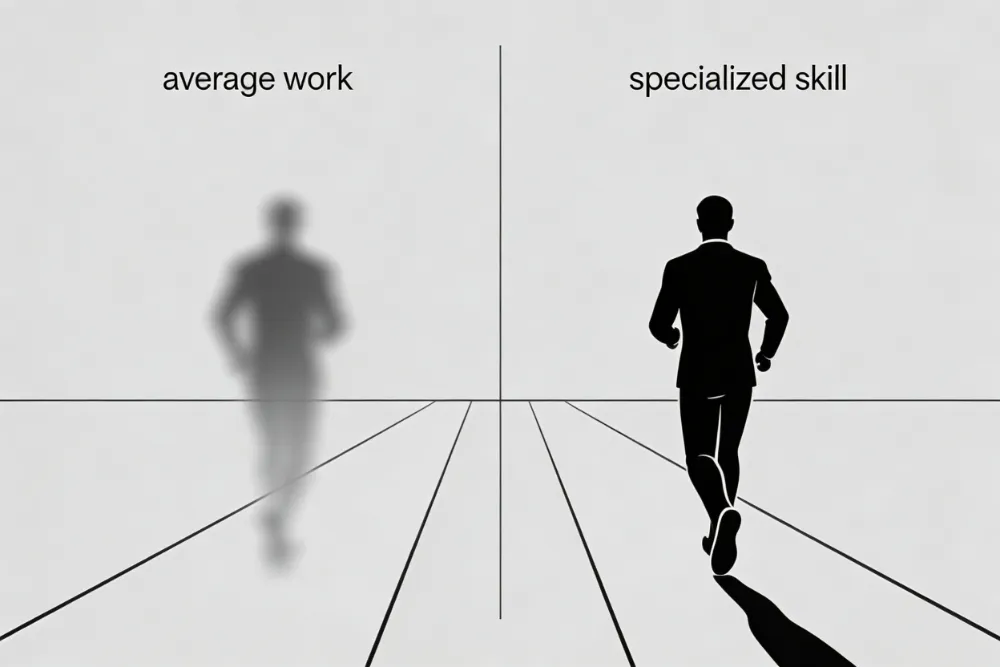
Here’s the uncomfortable part.
If your main value as a freelancer is “I write blog posts” or “I do graphic design,” and nothing more specific than that, you’re in a fragile position. Not because AI is better than you. But because clients who want average, fast, cheap output now have a tool that delivers exactly that.
According to Upwork’s Freelance Forward report, skilled freelancers with specialized expertise continue to see strong demand, while generalist work faces more pressure. The pattern is consistent across categories.
The freelancers losing work right now are mostly those who:
- Never developed a niche or real specialization
- Competed mostly on price rather than expertise
- Delivered technically fine work but nothing distinctive
- Treated every project as a transaction rather than a relationship
- Didn’t invest in learning new tools or evolving their process
None of that is AI’s fault. That positioning was already fragile. AI just made the weakness more visible.
What Strong Freelancers Are Actually Doing
I’ve worked alongside a lot of freelancers over the years. The ones doing well right now share a few clear habits.
They Got Specific About What They Do
Instead of “I’m a copywriter,” they became “I write email sequences for SaaS companies during product launches.” Instead of “I’m a video editor,” they became “I edit long-form YouTube content for finance creators.”
Specificity isn’t limiting. It’s what makes clients come to you instead of scrolling past you. A generalist competes with hundreds of people. A specialist is often the only obvious choice.
They Use AI as Part of Their Workflow
The freelancers doing well aren’t ignoring AI or fighting it. They’re using it to handle the repetitive, time-consuming parts of their process so they can put more energy into the work that actually requires human judgment.
A content writer using AI to research and outline spends more time on voice, story, and strategy. The client gets better work. The freelancer works smarter. That’s a real advantage, not a shortcut.
McKinsey’s research on automation and the future of work consistently shows that workers who combine technical skills with judgment and creativity are the most resilient to automation. That applies directly to freelancers.
They Focus on the Client Experience, Not Just the Output
This is something that doesn’t get talked about enough.
Clients don’t just remember what you made. They remember how the process felt. Did you communicate clearly? Did you ask the right questions early? Did you catch problems before they became expensive?
That experience is hard to put a price on, and impossible for any AI tool to replicate. A client who trusts you doesn’t shop around every time. That trust is one of the most valuable things you can build as a freelancer.
They Keep Learning Without Burning Out
Not chasing every trend. Not spending hours every day on YouTube watching tutorials. But consistently putting in time to stay current, one new skill per quarter, one tool explored per month. Staying curious rather than anxious.
LinkedIn’s 2024 Workplace Learning Report found that adaptability and continuous learning are among the top skills employers and clients look for. For freelancers, this translates directly into relevance.
A Simple Audit: How to Check Your Own Value
If you’re reading this and feeling uncertain about where you stand, here’s a practical exercise.
Ask yourself three honest questions:
1. What can I do that a well-crafted AI prompt cannot replace?
Think about your judgment, your relationships, your style, your experience. Write it down. Be specific.
2. Who benefits most from what I offer?
Not “small businesses” or “anyone who needs content.” Who exactly? The narrower and clearer your answer, the stronger your position.
3. What would a client actually miss if they used AI instead of me?
If you can’t answer this clearly, that’s your signal. Not to panic, but to work on it.
Your answers to these questions are your real competitive advantage. Build around them deliberately.
You Don’t Need to Become an AI Expert
A lot of advice right now tells freelancers to “learn AI,” “become a prompt engineer,” or rebuild their skill set from scratch. Most of that is noise.
You don’t need to be an AI expert. You need to be genuinely good at your craft, clear about who you serve, and willing to use AI as one useful tool among several. Like a photographer who doesn’t need to understand every technical spec of their camera. They need to know how to use it to create something worth looking at.
The fundamentals of good freelance work haven’t changed. Strong communication, reliable delivery, real expertise, and the ability to solve problems your clients don’t even know they have yet. Those things matter more now, not less.
This Moment Is Actually an Opportunity
A lot of average freelancers are leaving the market right now. They’re frustrated, pivoting out, or telling people AI ruined everything. That creates a gap.
Clients who want real quality, real strategy, and real creative thinking are looking harder than ever for someone who can actually deliver it. Harvard Business Review has written extensively about how automation tends to increase demand for high-skill, judgment-based work even while it replaces routine tasks. The pattern is playing out in freelancing too.
The bar for average work has dropped. The bar for excellent work has gone up. And that’s genuinely good news for anyone willing to meet it.
Final Thoughts
AI is a powerful shift. It’s changing how we work, what clients expect, and what skills are worth developing. Some of those changes are uncomfortable. Most of them are navigable.
The freelancers who build real expertise, adapt their workflows, develop genuine client relationships, and treat their craft seriously will always have a place. The question of whether AI will replace freelancers has a simple answer: no, not the good ones.
Staying average is the actual risk. Not the technology.
If this was useful, I write more on freelancing, digital work, and building a sustainable online career over the long term. Browse the blog or reach out if you want to talk through where you are in your freelance journey.

How to Get High-Paying Freelance Clients Without Upwork or Fiverr
High-paying freelance clients are not hiding on Upwork or Fiverr waiting for you to send another proposal. Most freelancers spend months bidding on projects, getting ignored, lowering their prices, and competing with hundreds of other people for the same opportunities.
Let me guess. You have probably been there too. You bid on projects, wait, get ignored, bid again, and sometimes land a client who barely pays enough to cover your time. You are not alone, and honestly, it does not have to stay that way.
After 8 years working in the digital space, helping freelancers and creators grow their businesses, the biggest shift I see is this: the freelancers earning the most are not the ones competing on platforms. They are the ones building real relationships and attracting clients directly.
Why Freelance Platforms Are Holding You Back
Platforms are not bad places to start. They give you your first clients, first reviews, and first experience. But they are designed to serve the platform, not you. The fees eat your margins, the competition keeps prices low, and the client relationship never really belongs to you.
Here is the bigger problem: on a platform, you are one of thousands. A client searching for a copywriter sees 200 profiles. They filter by price. They go with someone cheaper. You lose, even if you are clearly better.
When you go off-platform, the dynamic flips. You are not competing with 200 people anymore. You are having a real conversation with a business owner who needs help, and if you show up well, you are almost always the only person in the room.
Step 1: Build a Presence That Does the Selling for You
You do not need a fancy website right away. But you do need something that shows who you are, what you do, and who you help. Think of it as your digital handshake. Before a client ever talks to you, they will look you up.
LinkedIn: Your Most Underused Asset
Most freelancers treat LinkedIn like a resume. It is not. It is a place to show your thinking, share what you know, and build trust with the exact people who might hire you.
You do not need to post every day. Two or three times a week is enough. Share a short lesson from a recent project. Talk about a mistake you made and what you learned. Give away one useful tip for free. Over time, people start to see you as someone who knows what they are talking about.
A few things to focus on with your LinkedIn profile:
- Use a clear headline that says what you do and for whom. Example: ‘I help e-commerce brands write emails that actually convert.’
- Write your About section like you are talking to a client, not listing your achievements.
- Ask past clients or colleagues for a recommendation. Even one or two go a long way.
A Simple Website Goes a Long Way
Your website does not need to be 10 pages with animations. A one-page site with a clear headline, a short about section, your services, a few work samples, and a contact form is more than enough to start.
What matters is that it is clear. A client landing on your site should know within 5 seconds what you do and whether you can help them. If they have to read three paragraphs to figure that out, they will leave.
Step 2: Reach Out Directly (Without Being Annoying About It)
Cold outreach gets a bad reputation because most people do it wrong. They send a generic message, list their services, and ask for work. It feels transactional and lazy. The other person can smell it immediately.
The better approach is warm outreach. It means you research the person first, say something real, and make your message about them, not about you.
How to Write a Pitch That Gets Replies
Here is a simple formula that works:
- Start with something specific you noticed about their work.
- Mention one thing you think could be improved or a problem they might have.
- Briefly explain how you can help, with a relevant example.
- End with a low-pressure question, not a hard sell.
For example, instead of writing “Hi, I am a freelance copywriter with 5 years of experience. Let me know if you need help,” you write something like: “I noticed your last three newsletter subject lines were very similar. I have worked with a few SaaS brands on improving open rates and I think there is a small change that could make a real difference. Would you be open to a quick chat?”
Different energy entirely. And yes, it takes more effort. That is the point. Most people will not bother, which means you already stand out.
Step 3: Let Your Network Work for You
A huge number of freelance projects are filled through referrals. Someone asks in a group, “Does anyone know a good video editor?” and a name comes up. That name gets the project, no bidding required.
The question is, are you the name that comes up?
Building a referral network does not mean being pushy or asking people to promote you. It means staying visible, being helpful, and making it easy for people to think of you when the right opportunity comes up.
Simple Ways to Stay Top of Mind
- Join two or three online communities where your target clients hang out. Contribute, answer questions, be useful.
- Message past clients occasionally, not to sell, but just to check in and share something relevant.
- When you refer someone else for work, you build trust. People remember it and return the favor.
- Tell people clearly what you do. Many freelancers are invisible to their own friends and former coworkers.
Step 4: Use Content to Attract Clients Instead of Chasing Them
This is the long game, but it is the most powerful one. When you share useful content consistently, whether it is a LinkedIn post, a newsletter, a YouTube video, or even a thread, you are doing two things at once. You are showing your expertise, and you are building trust with people before they ever reach out to you.
I have seen freelancers land their best clients from a single blog post they wrote six months earlier. The client found it, read it, thought “this person knows what they are talking about,” and reached out directly. No bidding, no competing. Just a clean inbound inquiry.
You do not need to create content about everything. Pick one or two specific topics that are directly related to what you offer and go deep on those. Depth beats breadth, especially when you are starting out.
What to Write or Post About as a Freelancer
- Common mistakes your clients make in your area of expertise
- Behind-the-scenes of how you approach a project
- A quick tutorial or tip that solves a real problem
- What you have learned from working with a specific type of client or industry
- An opinion on something in your field. People remember those who have a clear point of view.
Step 5: Position Yourself as a Specialist, Not a Generalist
One of the fastest ways to charge more is to stop trying to do everything for everyone. Generalists compete on price. Specialists compete on value.
Think about it from the client side. If you are a B2B SaaS company and you need help with your email marketing, who are you going to hire? The copywriter who does “all types of content” or the one whose whole brand is about converting SaaS subscribers into paying users?
Specializing feels risky at first. But it almost always leads to better clients, better projects, and more money. You can still take on work outside your niche when needed. But your positioning tells the market who you are for, and that clarity attracts the right people.
One More Thing: Do Not Underestimate the Follow-Up
A lot of freelancers send one message and then disappear when they do not hear back. Here is something worth knowing: most clients are not ignoring you. They are just busy. A second or third touchpoint, spaced out and done with class, can make a real difference.
One week after an unanswered pitch, follow up with something useful. Share an article relevant to their business. Mention something you read that reminded you of a challenge they might be facing. Keep it short, keep it genuine.
You are not being annoying if you are being helpful. There is a real difference between spam and thoughtful persistence.
Common Questions Freelancers Ask Before Leaving Platforms
What If I Do Not Have Enough Experience Yet?
You probably have more value than you think. Many freelancers wait until they feel “ready” before putting themselves out there, but clients are often looking for someone reliable, responsive, and easy to work with, not just someone with 10 years of experience. Start small, build proof through personal projects or smaller clients, and improve as you go.
Can LinkedIn Really Bring Freelance Clients?
Absolutely. A strong LinkedIn presence can work like a long-term client magnet. You do not need thousands of followers either. Even a small audience can lead to opportunities if the right people are seeing your content and understanding your expertise.
How Many Outreach Messages Should I Send?
There is no magic number, but consistency matters more than volume. Sending 5 thoughtful messages is usually far more effective than sending 100 generic copy-paste pitches. Focus on quality conversations, not mass outreach.
Should I Lower My Prices to Get Clients?
In most cases, no. Low prices often attract difficult clients who care only about cost. Instead of competing on price, compete on clarity, communication, and specialization. Clients pay more when they trust that you understand their problems.
How Long Does It Take to Build a Stable Freelance Business?
Freelancing outside platforms is not instant, but it compounds over time. One client can lead to referrals, repeat work, and long-term partnerships. The goal is not just finding random projects. It is building a system where opportunities come to you consistently.
Do I Need a Website Before Reaching Out to Clients?
Not necessarily. A clean LinkedIn profile and a few solid work samples are enough to start. A website helps build credibility, but many freelancers land great clients before they ever launch one.
To Wrap It Up
Getting good clients without platforms is not some secret formula. It is just a different mindset. Instead of waiting and competing, you are putting yourself out there with intention, building real connections, and showing people what you can do before they even think to look for you.
It takes a little more effort upfront. But once it starts working, it compounds. A referral leads to another referral. A post you wrote gets shared. A past client recommends you to three friends. That is how a sustainable freelance business actually grows.
If you are ready to stop fighting for scraps on crowded platforms and start building something that works for you, try applying just one of these steps this week. Start with LinkedIn, write one honest post, or send one thoughtful outreach message. Small actions, done consistently, add up to something real.
Have a question about getting better freelance clients? Or a strategy that worked for you? I would love to hear it. Drop a comment or reach out directly.

Why Freelancers Fail (And How to Fix It Before It Breaks You)
Understanding why freelancers fail is not really about talent. Most of the time, it comes down to a handful of habits and mindset gaps that nobody ever talked to them about. I have seen it over and over again, and honestly, I fell into some of these traps myself early on.
You start freelancing full of energy. You land a few clients. Then somehow, by the end of the month, you are checking your bank account wondering where the money went. Sound familiar?
The good news: these problems are fixable. And once you see them clearly, you cannot unsee them. So let’s get into it.
1. You Are Trading Time for Money (And Running Out of Both)
This is probably the most common trap in freelancing. You charge by the hour, you work more hours, you make more money. Simple, right? Not exactly.
The problem is that there are only so many hours in a day. You hit a ceiling fast. And the moment you stop working, the income stops too. That is not a business. That is a job without the benefits.
The fix is to start thinking in value, not hours. What is the result you deliver? If your work helps a client generate 5,000 dollars in sales, charging them 20 dollars an hour makes zero sense. Package your services based on outcomes. Charge for what the work is worth, not how long it takes you.
What to do instead:
- Move from hourly rates to project-based or retainer pricing
- Define clear deliverables and outcomes in every proposal
- Ask clients what success looks like for them, then price around that
2. You Are Undercharging Because You Are Scared
I get it. When you are starting out, you are afraid to lose the client. So you lower your rate, throw in extra work for free, and say yes to everything. It feels like you are being flexible. But in reality, you are just devaluing your own work.
Here is something worth knowing: clients who pay low rates are often the most demanding. They come back with endless revisions, last-minute requests, and zero respect for your time. Meanwhile, higher-paying clients usually trust your expertise and let you do your job.
Charging more is not just about the money. It filters out the wrong clients and attracts the right ones. It also changes how you show up, because when you are paid fairly, you do better work.
A simple mindset shift:
Instead of thinking “will they say yes to this rate?” start asking “is this rate fair for the value I bring?” Those are very different questions, and they lead to very different outcomes.
3. You Have No Consistent Way to Get Clients
One month you are fully booked, the next month you are scrambling. This feast-or-famine cycle is one of the most stressful parts of freelancing. And almost always, it comes down to one thing: you only look for clients when you need money.
Finding clients should be a regular activity, not an emergency one. Think of it like watering a plant. You do not wait until it is dying to give it water. You build a habit.
The freelancers who earn steadily are not necessarily the most talented ones. They are the ones who show up consistently, whether that is through content, networking, outreach, or referrals. They are always planting seeds.
Practical ways to stay visible:
- Post content about your work or niche at least once a week
- Ask past clients for referrals or testimonials, do not wait for them to come to you
- Send a short follow-up message to old clients every couple of months
- Dedicate at least 30 minutes a day to outreach or visibility, even when you are busy
4. You Are Not Treating This Like a Business
This one is hard to hear, but I have to say it. Many freelancers treat their work like a side hustle even when they want full-time income from it. There is no budget, no savings, no structure. Just project to project, invoice to invoice.
A sustainable freelance career needs a few basic business habits. You need to know your numbers. How much do you need each month to cover expenses? What is your minimum rate to be profitable? How many clients do you need at once?
You do not need a business degree for this. A simple spreadsheet is enough to start. Track your income, your expenses, your unpaid invoices. When you see your numbers clearly, decisions get a lot easier.
Three basics every freelancer should have:
- A monthly income tracker (even a basic one)
- A contract or written agreement for every project, no matter how small
- A savings buffer of at least one month of expenses, built up over time
5. You Are Doing Everything Alone (And Burning Out Fast)
Freelancing can feel very lonely. You are the designer, the marketer, the accountant, the customer service rep, and the creative director all at once. That is a lot. And doing it all alone, without systems or support, leads to burnout faster than you expect.
One of the best things I did was start using simple tools and templates to reduce the time I spend on repetitive tasks. A good proposal template, a client onboarding checklist, a few automated emails. These things sound small, but they save hours every week.
Also, find a community. Other freelancers, even in different niches, can give you perspective, accountability, and referrals. You do not have to figure everything out alone.
6. You Have Not Built Any Asset That Works for You
Here is the longer game, and it is worth thinking about. Every piece of content you publish, every testimonial you collect, every skill you develop, these are assets. They work for you even when you are not actively working.
A blog post you wrote two years ago can still bring you clients today. A strong LinkedIn profile can do more outreach than you could manually in a week. A short email list, even with a few hundred people, can be more valuable than any job board.
Start small. Pick one platform and show up consistently. Write about what you know. Document your work. Share what you learn. Over time, this builds a presence that brings opportunities to you, instead of you always chasing them.
The Bottom Line
Being broke as a freelancer is rarely about talent. It is about patterns. And when you look closely at why freelancers fail, the same culprits come up: undercharging, inconsistent client work, no business structure, doing everything manually, and never building assets that compound over time.
The good part: every single one of these is fixable. You do not need to change everything at once. Pick one thing from this article and work on it this week. Just one. Then build from there.
I have spent 8 years navigating the ups and downs of freelancing and digital business. The patterns I see in struggling freelancers are almost always the same. And so are the breakthroughs once they shift something.
If any of this resonates with you, or if you have questions about your specific situation, feel free to drop a comment or reach out directly. I am happy to help.

How I Would Start Freelancing Today (If I Had to Start From Zero)
No portfolio. No network. No clue. Here’s what I’d actually do, and what I’d skip.
Let’s say tomorrow I wake up and everything’s gone. No clients, no reputation, no LinkedIn with 3,000 connections. Just me, a laptop, and some skills I haven’t proven to anyone yet.
What would I do? Honestly, I’ve thought about this a lot, because most freelancing advice is written by people who already have an audience, and they forget what zero really feels like.
So here’s my actual plan. Not the polished version. The real one.
“The biggest mistake beginners make isn’t charging too little. It’s trying to appeal to everyone and landing no one.”
Step 1: Pick one thing and one person
Not a service. Not a niche. One specific thing you can do, for one specific type of person.
Not “I do social media.” More like: ” I help small businesses manage their social media and create content that actually gets attention.” The narrower it sounds, the better it works, because that coffee shop owner feels like you’re talking directly to them.
You can always expand later. You can’t build anything on a foundation that vague.
Step 2: Get one paid project. Just one.
Not ten cold emails. Not a fancy website. One project that someone actually paid you for even if it’s $50. That’s your proof of concept. That’s what breaks the mental block.
Where to find it? Start with people you already know. Tell three friends what you’re doing. Ask if they know anyone who might need it. Most first clients come from one degree of separation, not from some cold outreach system.
→ Don’t wait to have a website first. A website is a tool for people who are already looking for you. Right now, nobody’s looking. Go to them.
Step 3: Do the work like your reputation depends on it
Because it does. Your first client isn’t just a paycheck, they’re a case study, a testimonial, and probably your first referral. Treat the project like you’re being paid ten times what you actually are.
Overcommunicate. Deliver early. Ask good questions before you start. Most freelancers lose repeat business not because the work was bad, but because the experience was mediocre.
Step 4: Turn one client into two
When the project is done and they’re happy, ask: “Do you know anyone else who might find this useful?” That’s it. No pitch, no awkward upsell. Just a genuine question.
Then repeat. Two becomes four. Four becomes eight. This is how a freelance practice actually grows, not virally, but one conversation at a time.
“You don’t need to be discovered. You need to be recommended.”
What I’d skip entirely
The stuff that feels productive but isn’t: spending three weeks on a brand identity, agonizing over your rates before you’ve talked to a single client, building a content strategy before you have one case study to write about.
All of that is future work. Right now, the only work that matters is getting in front of one real human who has a real problem you can solve.
The honest part nobody talks about
Starting from zero is uncomfortable in a way that’s hard to describe until you’re in it. You’ll feel like a fraud some days. You’ll second-guess your prices constantly. You’ll wonder if anyone will ever just find you instead of you always having to find them.
That phase doesn’t last forever, but it does last longer than most people expect. The freelancers who make it through it aren’t necessarily the most talented, they’re the ones who kept showing up when it felt pointless.
→ One client this week. Not a website. Not a logo. Not a pricing spreadsheet. One real person, one real conversation.
That’s where it starts. Everything else is just noise until you have that.
If you’re trying to start freelancing and feel stuck, you’re not alone. I’ve been through it, and I sometimes share what worked for me here.
Written for anyone staring at a blank slate and wondering where the first domino is. It’s closer than you think.